
Fed Up With All the Drama? You Could Be Caught Up in This Psychological Pattern
You're going around in circles: one minute you're trying to keep the peace and smooth things over, the next you're being blamed for the problem! You're fed up with having to take responsibility for other people's happiness. If that sounds familiar, you're not alone. It's called a Drama Triangle.
These are the three roles at the heart of the Drama Triangle — the Victim, the Persecutor, and the Rescuer. Most of us have been caught in a Drama Triangle at some point, often without even realising it. And once you're caught in the cycle, it can be hard to break free - until you recognise it.
The Drama Triangle model was first developed by the psychiatrist Stephen Karpman in the 1960s and is still very popular in modern-day therapy. Drama Triangles describe a situation where people take on certain roles; each person reinforcing unhelpful behaviours in the other - and so it goes on and on in a never ending cycle.
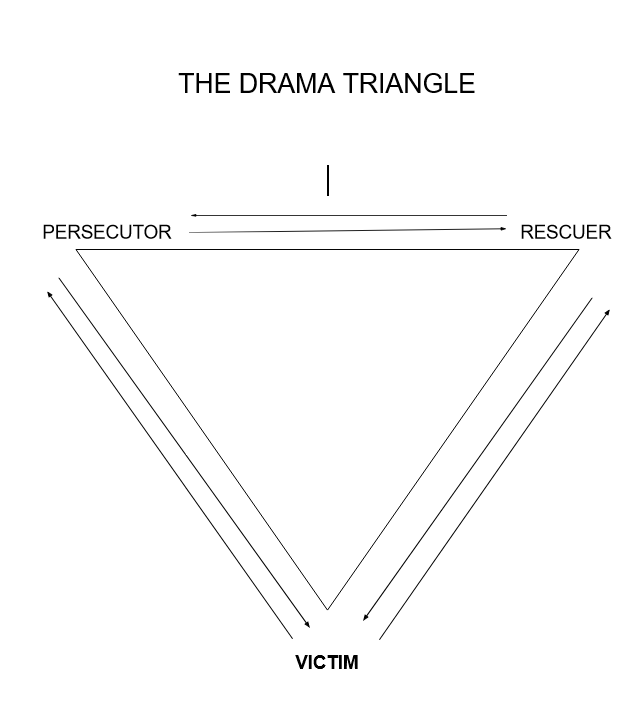
Here's An Example of a Drama Triangle playing out
David, and his wife, and son, had become caught up in an unhealthy pattern.
David was an easy going sort of person who loved his wife and his son dearly. However, his wife and son didn't always get on with each other very well.
His son Greg would complain to David about his mother, then she in turn would complain to David about their son. Stuck in the middle David would often find himself in the role of Rescuer trying his very best to bring them together. This had been going on for a long time. David was becoming more and more fed up with the situation.
The three of them were caught up in a Drama Triangle. (It's worth noting that this pattern can also manifest between two people or even a larger group because it's characterised by the three distinct roles, not each person.)
Persecutor, Victim and Rescuer
When David's son complained about his mother he was taking on the role of victim, making her the persecutor and expecting his father to be the rescuer.
When his wife complained to him about their son she was taking on the role of victim making their son the persecutor and again making David the rescuer.
David feeling overwhelmed by all this was feeling like the victim. Then, when David became frustrated and snapped back at either one of them, he himself would become the persecutor and they would become the victim. Plus, he told me, at times even though they didn’t generally get on, they would rescue each other when he snapped at them!
And so the three of them continued going around and around in these roles, unhappy and with nothing ever changing.
The thing to remember is that we all get caught up in Drama Triangles from time to time. It's not about one person being the 'baddie', and the others being good. It's simply a psychological drama that gets played out between people, with each role reinforcing the other and going back and forth.
How To RECOGNISE WHEN YOU'RE IN a drama Triangle
The good news is that once you recognise you're in a Drama Triangle you can break free from it. You can recognise when you're caught up in one by what's happening in your relationships. If you feel like a victim, or that you have to rush in and save someone, or you keep being cast as the bad person- then its likely you're caught up in a Drama Triangle.
Some common signs can be:
- You or another person, behaves in ways that are too intense rather than responding in a calm and rational way.
- Emotions often feel overwhelming.
- You're taking on too much responsibility for someone else's happiness.
- You're not taking responsibility for your own happiness.
- Your relationship feels unpredictable and chaotic.
- You or another person often becomes defensive.
- You notice that you, or another person, is often apologising.
If any of this feels familiar, take a moment to step back and consider how these roles might be playing out - and please don't judge yourself if you realise you're in a Drama Triangle. Most of us have this experience in different relationships from time to time.
are You Ready to Step Out of the DRAMA Triangle?
The next time you find yourself in a familiar, painful dynamic — pause. Take a breath. And ask yourself: could I be caught in a Drama Triangle right now?
The answer will very often be yes. And that's okay. What matters is that you're willing to see it because that moment of awareness is where everything begins to change.
And once you can see it, the next most powerful thing you can do is start setting clearer boundaries - because you don't have to stay stuck in cycles that drain you. You have the ability to recognise these patterns and respond differently.
Learning how to set clear, confident boundaries is the key - and if you'd like help with that, my free weekly tips, Find Courage To Be You, are for you. Tell me where to send them in the form below and join a community of people who are getting the very best from their life and relationships.
Get your tips, inspiration and guidance on setting confident boundaries and finding courage to ask for what you need.